Friday, June 26, 2009

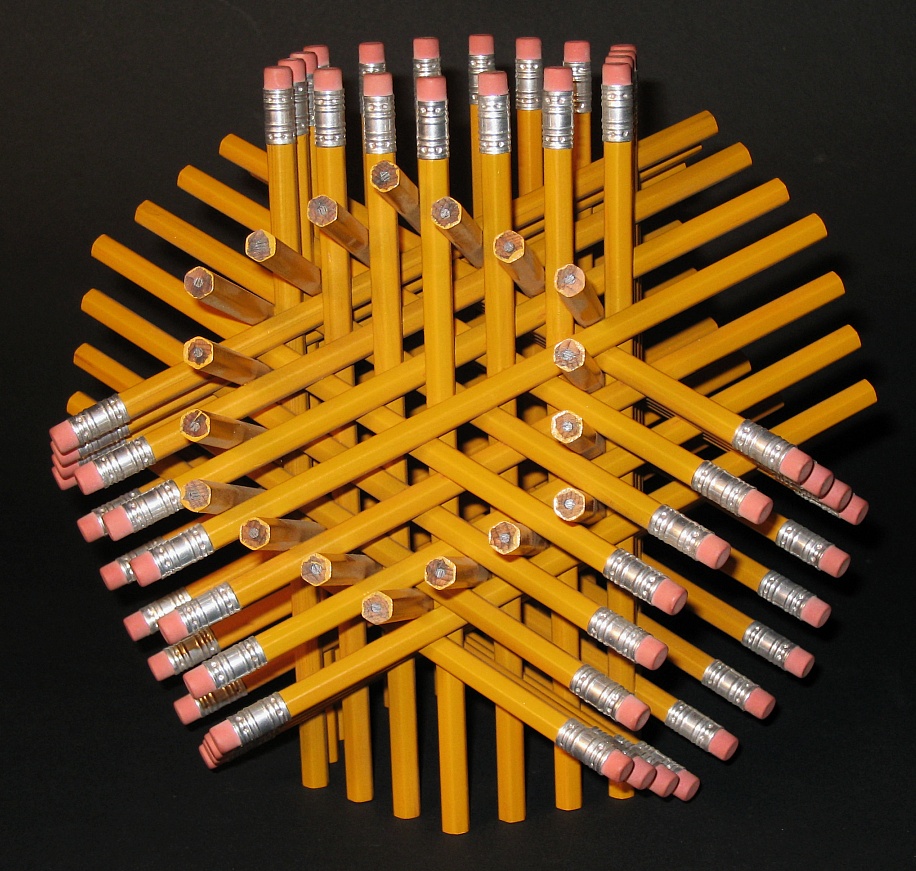
I, Pencil


Cafe Hayek directed me to this essay, which I enjoyed thoroughly. It is the story of how a pencil is made, which seems boring at first, but the perspective taken illuminates the wonder of free markets beautifully.

Here are some excerpts:

You may wonder why I should write a genealogy. Well, to begin with, my story is interesting. And, next, I am a mystery—more so than a tree or a sunset or even a flash of lightning. But, sadly, I am taken for granted by those who use me, as if I were a mere incident and without background. This supercilious attitude relegates me to the level of the commonplace. This is a species of the grievous error in which mankind cannot too long persist without peril. For, the wise G. K. Chesterton observed, "We are perishing for want of wonder, not for want of wonders."
Actually, millions of human beings have had a hand in my creation, no one of whom even knows more than a very few of the others. Now, you may say that I go too far in relating the picker of a coffee berry in far off Brazil and food growers elsewhere to my creation; that this is an extreme position. I shall stand by my claim. There isn't a single person in all these millions, including the president of the pencil company, who contributes more than a tiny, infinitesimal bit of know-how. From the standpoint of know-how the only difference between the miner of graphite in Ceylon and the logger in Oregon is in the type of know-how. Neither the miner nor the logger can be dispensed with, any more than can the chemist at the factory or the worker in the oil field—paraffin being a by-product of petroleum.
I, Pencil, am a complex combination of miracles: a tree, zinc, copper, graphite, and so on. But to these miracles which manifest themselves in Nature an even more extraordinary miracle has been added: the configuration of creative human energies—millions of tiny know-hows configurating naturally and spontaneously in response to human necessity and desire and in the absence of any human master-minding! Since only God can make a tree, I insist that only God could make me. Man can no more direct these millions of know-hows to bring me into being than he can put molecules together to create a tree.
Don Boudreaux adds,
Whenever I hear or read someone proclaim that "the market doesn't work," I try (if the situation permits) to ask him or her how is it that an ordinary pencil exists. Its production requires the cooperation of literally millions of people from around the world. Not one in one-thousand of these people know each other. Many of them, were they to meet, would positively hate each other. And yet, pencils exist in appropriate abundance, and can be acquired almost free of charge. (If you're in the United States, go up to strangers on the street, in shopping malls, or at your school or workplace and ask for a pencil. You'll not wait long before someone gives you one without expecting it to be returned. I do this experiment frequently; it works.)
To be fair, lets not forget to consider the statist take on this whole process:

But, but you need a government person to supervise the transaction. So first we must pass laws, and then create the departments of pencils. Then when someone's pencil tip breaks, they will call their senator and demand government do something about breaking pencil tips. A new set of regulations will appear, with the promise that this time it will fix the problem. The cost of pencils go up, sales go down, and the pencil lobby descends on Washington to add pens to the regulations. The department of pencils gets bigger, but pencil tips keep breaking and wearing out.

I will let someone else finish the story, as it never ends. (from comments @ Cafe Hayek)

I think there is a product out there for each person that will make the idea of "I, Pencil" clear to them. For me it is the existence of the grocery store. The myriad of products, some at incredibly cheap prices, oftentimes appear miraculous to me. The cost of a plastic bag at Wegmans, I am told by the cashier, is 25 cents. The cost of a can of corn, on sale, is 39 cents. That a can of corn - with all the division of labor that went into growing and harvesting the corn, the canning process, designing the label, and being shipped throughout the country - costs marginally more than a plastic bag is in my mind a great wonder in the world.

Thursday, June 25, 2009

Fresh produce 6.25.09

Mish has a fantastic post today using Dr. Seuss to explain economic realities.

1. Thidwick the Big-Hearted Moose, an illustrated tale.

2. While the Fed is getting more power, no one is forcing them to face the consequences of a recent cover up.

3. Spezify is a very interesting new search engine. Compare it to Wolfram Alpha and Bing. Or the classic.

4. Legislators in Cali want to pay for their debts in IOU's. My question is, who in their right mind would lend them money?

Monday, June 15, 2009

States' Rights and the Future of the Republic(s)


Some time ago a former KGB agent predicted the breakup of the USA. At the time I scoffed at his prediction, and wrote it off as a bitter rant from someone who wished the USSR was reunited and a global power. Yet after some thought (and reading Watchmen) I realized that there is no magical quality to the USA. There is absolutely no reason why the empire could not falter and dissolve. Here are some real organizations and signs about the roots of a new secession/States' rights movement not seen in my brief lifetime.

1. The Wall Street Journal on the dynamics of liberty and secession, and the future of the States in America.

2. The Christian Exodus, a secessionist movement based in S. Carolina. In their words: "The initial goal was to move thousands of Christian constitutionalists to South Carolina to accelerate the return to self-government based upon Christian principles at the local and State level."

3. The Patrick Henry Caucus was formed to organize legislators and find ways to strengthen the 10th Amendment. In their words: "We affirm that the federal government may exercise only those rights and powers that are specifically granted unto it by the Constitution and no others. We reassert the sovereignty and rights of the individual states."

4. The Free State Project was organized to concentrate the efforts of liberty-loving folk in one state, and use the political system to preserve and reinforce self-government. In their words: "...the fullest practical effort toward the creation of a society in which the maximum role of civil government is the protection of life, liberty, and property."

5. The Second Vermont Republic is, in their words, "... a nonviolent citizens' network and think tank opposed to the tyranny of Corporate America and the U.S. government, and committed to the return of Vermont to its status as an independent republic and more broadly to the dissolution of the Union."

There is a common thread in all of these organizations. Many Americans still identify with the concept of self-government. If there is one principle that the USA was founded upon, it is self-government. There is a strong undercurrent of conservatism in the USA. Democratic states (Vermont) and Republican states (New Hampshire) both desire to preserve their right to self-governance. The WSJ article makes a compelling case that things would be better if what we know to be the Union were broken up into several nation-states. I tend to agree.

Thursday, June 11, 2009

Fresh Produce 6.11.09

Man things are happening so fast and getting so crazy.

1. Australian police will now also be "carbon cops". Excerpt:
"The Government is effectively saying to us, 'Ignore other crime types'," Australian Federal Police Association chief Jim Torr said. ... Mr Torr said breaking carbon trading laws would be like breaking other laws. "These offences will constitute another federal crime type, along with narcotics importing, people smuggling and all the rest of it, that the AFP will be expected to police," he said. "I can see very complex, covert investigations . . . a lot of scientific expertise required."
2. Macroeconomists can basically say whatever they want. Excerpt:
But macroeconomists can almost always claim to be right, no matter what happens. If they recommend Policy X and the economy weakens, they can say it prevented a complete disaster. If they say Policy X will hurt and things improve, they can say without it, things would have been even better. Being a macroeconomist means never having to say you're sorry.
3. Apparently we are embarking on massive new price fixing.

4. In further proof that things are really crazy, here is a meat dress.

Wednesday, June 10, 2009

Jaguar Inflation


Found this over at Economics Junkie. A very clear illustration of how foolish and hopeless bubble blowing can be.

Written by Robert Prechter:

Jaguar Inflation

I am tired of hearing people insist that the Fed can expand credit all it wants. Sometimes an analogy clarifies a subject so let’s try one.

It may sond crazy, but suppose the government were to decide that the health of the nation depends upon producing Jaguar automobiles and providing them to as many people as possible. To facilitate that goal, it begins operating Jaguar plants all over the country, subsidizing it with tax money. To everyone’s delight , it offers these luxury cars for sale at 50 percent off the old price. People flock to the showrooms and buy. Later, sales slow down, so the government cuts the price in half again. More people rush in and buy. Sales again slow, so it lowers the price to $900 each. People return to the stores and buy two or three, or half a dozen. Why not? Look how cheap they are! Buyers give Jaguars to their kids and park an extra one on the lawn. Finally, the country is awash in Jaguars. Alas, sales slow again, and the government panics. It must move more Jaguars, or, according to its theory - ironically now made fact - the economy will recede. People are working three days a week just to pay their taxes so the government can keep producing more Jaguars. If Jaguars stop moving the economy will stop. So the government begins giving Jaguars away. A few more cars move out of the showrooms, but then it ends. Nobody wants any more Jaguars. They don’t care if they’re free. They can’t find a use for them. Production of Jaguars ceases. It takes years to work through the overhanging supply of Jaguars. Tax collections collapse, the factories close, and unemployment soars. The economy is wrecked. People can’t afford to buy gasoline , so many of the Jaguars rust away to worthlessness. The number of Jaguars - at best - returns to the level it was before the program began.

The same thing can happen with credit.
It may sound crazy, but suppose the government were to decide that the health of the nation depends upon producing credit and providing it to as many people as possible. To facilitate that goal, it begins operating credit production plants all over the country, called Federal Reserve Banks. To everyone’s delight , the banks offer the credit for sale at below market rates. People flock to the banks and buy. Later, sales slow down, so the banks cut the price again. More people rush in and buy. Sales again slow, so it lowers the price to 1 percent. People return to the banks and buy even more credit. Why not? Look how cheap it is! Borrowers use credit to buy houses, boats and an extra Jaguar to park out on the lawn. Finally, the country is awash in credit. Alas, sales slow again, and the banks panic. They must move more credit, or, according to its theory - ironically now made fact - the economy will recede. People are working three days a week just to pay the interest on their debt so the banks can keep offering more credit. If credit stops moving the economy will stop. So they start giving credit away at zero percent interest. A few more loans move through the tellers’ windows, but then it ends. Nobody wants any more credit. They don’t care if they’re free. They can’t find a use for it. Production of credit ceases. It takes years to work through the overhanging supply of credit. Interest payments collapse, banks close, and unemployment soars. The economy is wrecked. People can’t afford to pay interest on their debts , so many bonds deteriorate away to worthlessness. The value of credit - at best - returns to the level it was before the program began.

Tuesday, June 9, 2009

The confusion between right and left

I am generally intrigued by the misuse of language in American politics. In the popular consciousness liberals stand for big government while conservatives stand for limited government. Liberals believe in civil rights and personal liberty but favor high taxes and government services. Conservatives believe in free markets but have a poor record favoring government control of personal liberties. If the word liberal is derived from liberty, why are they the 21st century statists? How did the word "conservative" become associated with liberty and small government?

The following quotes come from a very interesting speech by Roderick T. Long, called Rothbard's "Left and Right": Forty Years Later, given at the Austrian Scholars Conference in 2006.

Rothbard:
[T]here developed in Western Europe two great political ideologies … one was liberalism, the party of hope, of radicalism, of liberty, of the Industrial Revolution, of progress, of humanity; the other was conservatism, the party of reaction, the party that longed to restore the hierarchy, statism, theocracy, serfdom, and class exploitation of the Old Order…. Political ideologies were polarized, with liberalism on the extreme "left," and conservatism on the extreme "right," of the ideological spectrum.
Herbert Spencer:
How is it that Liberalism, getting more and more into power, has grown more and more coercive in its legislation? For what, in the popular apprehension and in the apprehension of those who effected them, were the changes made by Liberals in the past? They were abolitions of grievances suffered by the people…. [T]his was the common trait they had which most impressed itself on men's minds…. [T]he welfare of the many came to be conceived ... as the aim of Liberalism. Hence the confusion. The gaining of a popular good, being the external conspicuous trait common to Liberal measures in earlier days (then in each case gained by a relaxation of restraints), it has happened that popular good has come to be sought by Liberals, not as an end to be indirectly gained by relaxations of restraints, but as the end to be directly gained. And seeking to gain it directly, they have used methods intrinsically opposed to those originally used.
Long:
In short, Spencer's analysis is that liberals came to conceptualize liberalism in terms of its easily identifiable effects (benefits for the masses) rather than in terms of its essential nature (laissez-faire), and so began to think that any measure aimed at the end of benefits for the masses must count as liberal, whether pursued by the traditional liberal means of laissez-faire or by its opposite, the traditional Tory means of governmental compulsion. In short, liberalism became the pursuit of liberal ends by Tory means.
Rothbard:
Libertarians of the present day are accustomed to think of socialism as the polar opposite of the libertarian creed. But this is a grave mistake, responsible for a severe ideological disorientation of libertarians in the present world. As we have seen, conservatism was the polar opposite of liberty; and socialism, while to the "left" of conservatism, was essentially a confused, middle-of-the-road movement. It was, and still is, middle-of-the-road because it tries to achieve liberal ends by the use of conservative means…. Socialism, like liberalism and against conservatism, accepted the industrial system and the liberal goals of freedom, reason, mobility, progress, higher living standards for the masses, and an end to theocracy and war; but it tried to achieve these ends by the use of incompatible, conservative means: statism, central planning, communitarianism, etc.

Originally liberalism was a movement whose goal was the promote the common good. The means of achieving the common good was through liberty, not through state control. Over time liberalism came to mean achieving the common good through state control. This is a confusion of means and ends, of indirect and direct, and ultimately of freedom and tyranny.