Thursday, June 11, 2009

Fresh Produce 6.11.09

Man things are happening so fast and getting so crazy.

1. Australian police will now also be "carbon cops". Excerpt:
"The Government is effectively saying to us, 'Ignore other crime types'," Australian Federal Police Association chief Jim Torr said. ... Mr Torr said breaking carbon trading laws would be like breaking other laws. "These offences will constitute another federal crime type, along with narcotics importing, people smuggling and all the rest of it, that the AFP will be expected to police," he said. "I can see very complex, covert investigations . . . a lot of scientific expertise required."
2. Macroeconomists can basically say whatever they want. Excerpt:
But macroeconomists can almost always claim to be right, no matter what happens. If they recommend Policy X and the economy weakens, they can say it prevented a complete disaster. If they say Policy X will hurt and things improve, they can say without it, things would have been even better. Being a macroeconomist means never having to say you're sorry.
3. Apparently we are embarking on massive new price fixing.

4. In further proof that things are really crazy, here is a meat dress.

Wednesday, June 10, 2009

Jaguar Inflation


Found this over at Economics Junkie. A very clear illustration of how foolish and hopeless bubble blowing can be.

Written by Robert Prechter:

Jaguar Inflation

I am tired of hearing people insist that the Fed can expand credit all it wants. Sometimes an analogy clarifies a subject so let’s try one.

It may sond crazy, but suppose the government were to decide that the health of the nation depends upon producing Jaguar automobiles and providing them to as many people as possible. To facilitate that goal, it begins operating Jaguar plants all over the country, subsidizing it with tax money. To everyone’s delight , it offers these luxury cars for sale at 50 percent off the old price. People flock to the showrooms and buy. Later, sales slow down, so the government cuts the price in half again. More people rush in and buy. Sales again slow, so it lowers the price to $900 each. People return to the stores and buy two or three, or half a dozen. Why not? Look how cheap they are! Buyers give Jaguars to their kids and park an extra one on the lawn. Finally, the country is awash in Jaguars. Alas, sales slow again, and the government panics. It must move more Jaguars, or, according to its theory - ironically now made fact - the economy will recede. People are working three days a week just to pay their taxes so the government can keep producing more Jaguars. If Jaguars stop moving the economy will stop. So the government begins giving Jaguars away. A few more cars move out of the showrooms, but then it ends. Nobody wants any more Jaguars. They don’t care if they’re free. They can’t find a use for them. Production of Jaguars ceases. It takes years to work through the overhanging supply of Jaguars. Tax collections collapse, the factories close, and unemployment soars. The economy is wrecked. People can’t afford to buy gasoline , so many of the Jaguars rust away to worthlessness. The number of Jaguars - at best - returns to the level it was before the program began.

The same thing can happen with credit.
It may sound crazy, but suppose the government were to decide that the health of the nation depends upon producing credit and providing it to as many people as possible. To facilitate that goal, it begins operating credit production plants all over the country, called Federal Reserve Banks. To everyone’s delight , the banks offer the credit for sale at below market rates. People flock to the banks and buy. Later, sales slow down, so the banks cut the price again. More people rush in and buy. Sales again slow, so it lowers the price to 1 percent. People return to the banks and buy even more credit. Why not? Look how cheap it is! Borrowers use credit to buy houses, boats and an extra Jaguar to park out on the lawn. Finally, the country is awash in credit. Alas, sales slow again, and the banks panic. They must move more credit, or, according to its theory - ironically now made fact - the economy will recede. People are working three days a week just to pay the interest on their debt so the banks can keep offering more credit. If credit stops moving the economy will stop. So they start giving credit away at zero percent interest. A few more loans move through the tellers’ windows, but then it ends. Nobody wants any more credit. They don’t care if they’re free. They can’t find a use for it. Production of credit ceases. It takes years to work through the overhanging supply of credit. Interest payments collapse, banks close, and unemployment soars. The economy is wrecked. People can’t afford to pay interest on their debts , so many bonds deteriorate away to worthlessness. The value of credit - at best - returns to the level it was before the program began.

Tuesday, June 9, 2009

The confusion between right and left

I am generally intrigued by the misuse of language in American politics. In the popular consciousness liberals stand for big government while conservatives stand for limited government. Liberals believe in civil rights and personal liberty but favor high taxes and government services. Conservatives believe in free markets but have a poor record favoring government control of personal liberties. If the word liberal is derived from liberty, why are they the 21st century statists? How did the word "conservative" become associated with liberty and small government?

The following quotes come from a very interesting speech by Roderick T. Long, called Rothbard's "Left and Right": Forty Years Later, given at the Austrian Scholars Conference in 2006.

Rothbard:
[T]here developed in Western Europe two great political ideologies … one was liberalism, the party of hope, of radicalism, of liberty, of the Industrial Revolution, of progress, of humanity; the other was conservatism, the party of reaction, the party that longed to restore the hierarchy, statism, theocracy, serfdom, and class exploitation of the Old Order…. Political ideologies were polarized, with liberalism on the extreme "left," and conservatism on the extreme "right," of the ideological spectrum.
Herbert Spencer:
How is it that Liberalism, getting more and more into power, has grown more and more coercive in its legislation? For what, in the popular apprehension and in the apprehension of those who effected them, were the changes made by Liberals in the past? They were abolitions of grievances suffered by the people…. [T]his was the common trait they had which most impressed itself on men's minds…. [T]he welfare of the many came to be conceived ... as the aim of Liberalism. Hence the confusion. The gaining of a popular good, being the external conspicuous trait common to Liberal measures in earlier days (then in each case gained by a relaxation of restraints), it has happened that popular good has come to be sought by Liberals, not as an end to be indirectly gained by relaxations of restraints, but as the end to be directly gained. And seeking to gain it directly, they have used methods intrinsically opposed to those originally used.
Long:
In short, Spencer's analysis is that liberals came to conceptualize liberalism in terms of its easily identifiable effects (benefits for the masses) rather than in terms of its essential nature (laissez-faire), and so began to think that any measure aimed at the end of benefits for the masses must count as liberal, whether pursued by the traditional liberal means of laissez-faire or by its opposite, the traditional Tory means of governmental compulsion. In short, liberalism became the pursuit of liberal ends by Tory means.
Rothbard:
Libertarians of the present day are accustomed to think of socialism as the polar opposite of the libertarian creed. But this is a grave mistake, responsible for a severe ideological disorientation of libertarians in the present world. As we have seen, conservatism was the polar opposite of liberty; and socialism, while to the "left" of conservatism, was essentially a confused, middle-of-the-road movement. It was, and still is, middle-of-the-road because it tries to achieve liberal ends by the use of conservative means…. Socialism, like liberalism and against conservatism, accepted the industrial system and the liberal goals of freedom, reason, mobility, progress, higher living standards for the masses, and an end to theocracy and war; but it tried to achieve these ends by the use of incompatible, conservative means: statism, central planning, communitarianism, etc.

Originally liberalism was a movement whose goal was the promote the common good. The means of achieving the common good was through liberty, not through state control. Over time liberalism came to mean achieving the common good through state control. This is a confusion of means and ends, of indirect and direct, and ultimately of freedom and tyranny.

Fresh Produce 6.9.09

1. Does the current US govt hate business? "The economically illiterate partisan Democratic view is that this practice is unpatriotic and bleeds jobs from the U.S. The economic reality is that American companies use this approach to acquire market share overseas. The alternative is losing the business to foreign competitors."

2. "The Federal Reserve intends to hire a veteran lobbyist as it seeks to counter skepticism in Congress about the central bank’s growing power..." Apparently Ron Paul is having an effect.

3. This interview with Gerald Celente conjures images of Ozymandias in Watchmen with all his video feeds. Excerpt: "Washington has declared 'Economic Martial Law'. Wall Street is putting Main Street out of business. The key to watch is Christmas sales. They’ll fail. Christmas will be when reality sets in."

4. A Socratic dialogue on free markets and social welfare. One of the studies quoted therein:
A conservative estimate of the welfare gain to a moderately skilled worker in the median country of our sample moving to the US is P$10,000 per worker, per year, roughly double income per capita of the developing world in aggregate.
Barriers to entry in labor markets keep people poor and unemployed. Unintended consequence, of course.

Friday, June 5, 2009

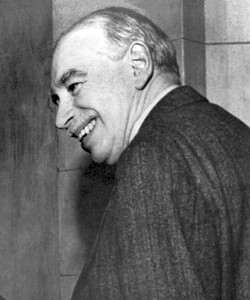
Keynes on Inflation

This is somewhat of a cross-post from Cafe Hayek, but I'd like to expound on it. John Maynard Keynes is an economist whose ideas have shaped government policy since the early 20th century. His ideas are the heart and soul of stimulus plans all over the world. Stimulus is supposed to be the antidote to massive deflation and the paradox of thrift. The government prints or borrows money for spending now, to "stimulate" the economy and improve private consumption rates. This policy is inherently inflationary, and it must be so. The only way to combat deflation is through inflation.

That being said, it is important to take a look at what Keynes himself said about the consequences of inflation:

By a continuing process of inflation, governments can confiscate, secretly and unobserved, an important part of the wealth of their citizens. By this method, they not only confiscate, but they confiscate arbitrarily; and, while the process impoverishes many, it actually enriches some. The sight of this arbitrary rearrangement of riches strikes not only at security, but at confidence in the equity of the existing distribution of wealth. Those to whom the system brings windfalls . . . become 'profiteers', who are the object of the hatred of the bourgeoisie, whom the inflationism has impoverished not less than the proletariat. As the inflation proceeds . . . all permanent relations between debtors and creditors, which form the ultimate foundation of capitalism, become so utterly disordered as to be almost meaningless. (from pages 220-233 of The Economic Consequences of the Peace (1919))

Some will point out that he begins by stating that a "continuing process of inflation", and that perhaps a one time stimulus would be good. Let's look at the value of the dollar after we completely abandoned commodity money in 1971. (chart from here)


Look at what happened to the cost of living when the USA went off the gold standard. We are clearly in a "continuing process of inflation". Let's look at the lower part of the graph for some interesting events in US history.
  • 1860-1865: Funding the civil war creates massive inflation.
  • 1913-1920: The Fed is created, an agricultural depression occurs.
  • 1930-1940: The Great Depression.
  • 1940-1945: Funding WWII.
  • 1970-1980: End of Bretton-Woods
  • 1980-present: Stable 2-3% inflation
There is a divergence in the two graphs, as inflation appears to be stable at 2-3%, the cost of living skyrockets. If inflation is low and constant why would the cost of living grow so rapidly? What is the cause? Not allowing a deflationary force to manifest is to create an inflationary force. Before 1940 we had alternating periods of deflation and inflation, which gave us stable average prices over time. There basically has been no net deflation since 1940, only varying degrees of inflation. That is why the cost of living has gone up year after year. You can thank these guys.

To your left you'll see a table charting the declining value of the dollar since the creation of the Federal Reserve in 1913. The dollar lost 50% of its value (you need twice as many dollars for the same purchasing power) between 1913-1920, 1920-1970, 1970-1980, 1980-2000. From 1913-2008 the dollar has lost ~95% of its value.

Now that continuing process of inflation is clear, lets revisit some of the consequences that Keynes' spoke of:
  • Governments can, in a hidden way, arbitrarily confiscate the wealth of their citizens.
  • Typically the poor and middle class lose money while foreign and domestic banks and other financial institutions profit from inflation.
  • When the poor and middle class see this arbitrary rearrangement of riches, it is blamed on capitalism.
  • Eventually the relationship between creditors and debtors is so distorted that the debtors will never possibly be able to pay back what they owe, and so the two terms become essentially meaningless.

Keynes is saying that inflation can be dangerous. Not in the mere sense that people will lose value of their money, but that it undermines the entire system of capitalism! Nowadays, deflation is a dirty word. In the not so distant future inflation will be the dirty word. The truth is that there are no dirty words in economics, but in politics. This is what is happening in the USA. Furthermore, the politicians are acting on the assumption that we are not in a "continuing process of inflation" and thus a one time "stimulus" would possibly work. Keynes implies that is an exceedingly dangerous assumption.

Happy birthday John Maynard Keynes
June 5, 1883 - April 21 1946


Tuesday, June 2, 2009

Fresh produce from the link farm 6.2.09

1. Romania's former communist car czar writes about his experience.

2. Gerald Celente is excellent in "Looking Back On The Greatest Depression".

3. John Stossel compares economic stimulus to "Pyramids, earthquakes, and wars".

4. Russel Roberts over @ Cafe Hayek doesn't understand why the media cares so much about Obama's personal expenditures. The more the better, right?

5. Peter Schiff's first "political" talk. He tells the Libertarian Party candidates not to run in the Libertarian Party. Worth a look.